

You might have noticed those hoops peeking from people’s ears in a spot that’s surprisingly hard to see? Looks cool, right? That’s a daith piercing, and recently it has become popular again. Although it’s been around since the 90s, it remains mysterious. In this article, we will learn what exactly this daith piercing is, what to expect if you are considering one, and also we will find the reality behind its claim to cure migraines.
What Are Daith Piercings?
First, we need to understand what it is and where people wear it.
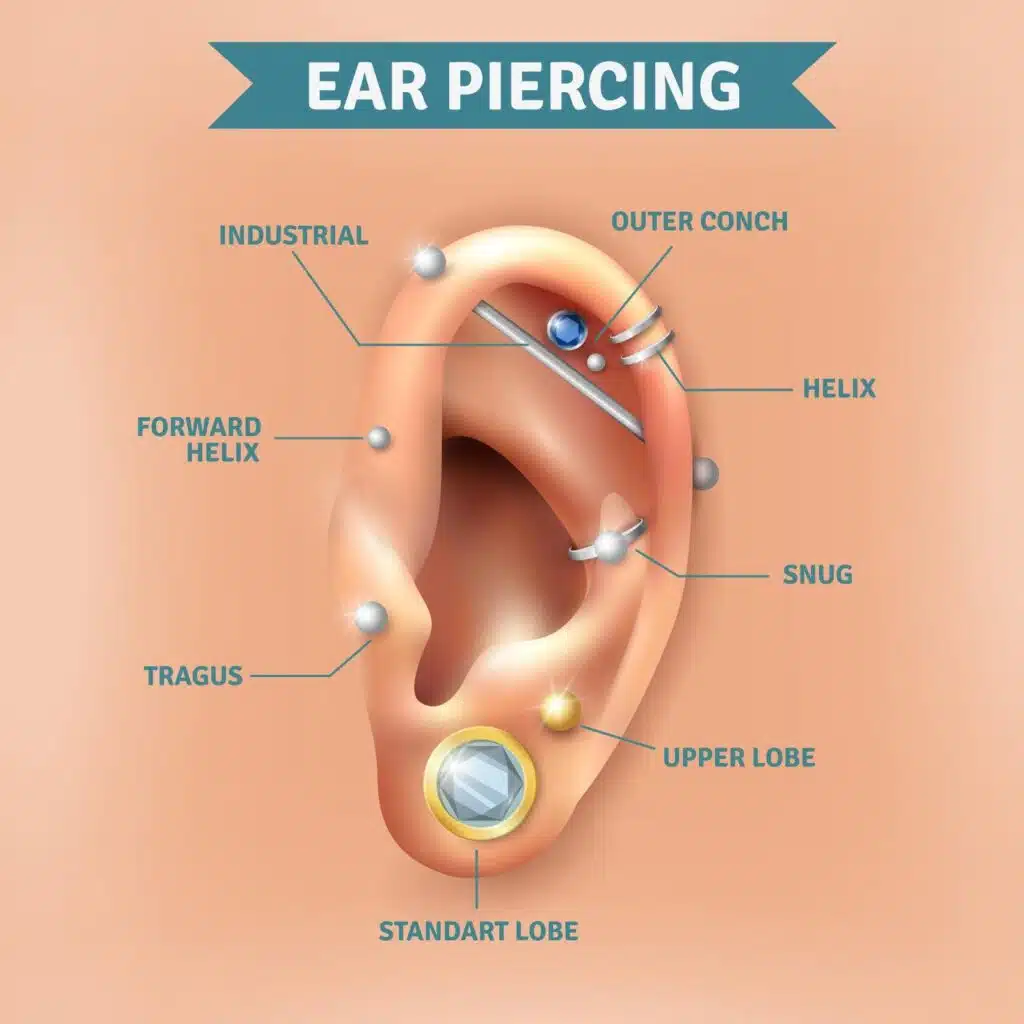
The daith piercing passes through the innermost fold of your ear cartilage, specifically an area called the crus of the helix (1).
If you’re trying to visualize it, imagine the small curved ridge of cartilage that sits just above your ear canal; that’s where this piercing goes. We will share a pic below, so that will give you an idea.
As it’s hidden in the heart, that’s what makes it unique and visually appealing.
The term “daith” comes from the Hebrew word “da’at,” which means knowledge. This piercing was first popularized in the early 90s by a piercer named Erik Dakota, and it’s been popular since (2).The funny thing is, there’s a debate about how it’s pronounced.
It’s pronounced “doth” (rhymes with “goth”), not “day-th, which surprisingly looks more common and acceptable.
Does Daith Piercing Hurt – How Painful Is It?
Most people rate the daith piercing pain level at around 2 to 3 out of 10, which means it’s uncomfortable but bearable.
However, we also need to say that pain tolerance could be incredibly personal and may also include where and how you are getting it, which means the skills of a piercer.
A seasoned piercer who performs daith piercings regularly will have a refined technique, better positioning, and a faster process, all of which can reduce the pain.
And not to forget, the thickness of your specific cartilage also plays a role; some people naturally have thicker ear tissue than others.
Generally, it has been noticed that psychological state matters too. If you are going in relaxed with realistic expectations, the experience will be a lot easier as compared to when you are anxious and tense.
Some people who have a daith piercing pointed out that it’s much better if this procedure is not done with a piercing gun (3).
Piercing guns are designed for soft tissue, like earlobes, and are not appropriate for cartilage. They are difficult to sterilize properly, and may increase infection risk and scarring. Always seek a professional piercer who uses a hollow needle technique (4).
The Healing Process – How Long Does a Daith Piercing Takes to Heal?
A daith piercing typically takes 6 to 9 months to fully heal, though some people experience complete healing up to 12 months. This extended timeline exists because cartilage has less blood flow than other tissues, which means it heals more slowly than you would expect.
As it is tucked deep in your ear, it is genuinely difficult to see while you are cleaning it. The piercing also sits right where your ear rests against pillows at night, which means sleeping pressure can cause complications. Additionally, your hair, clothing, and even ear hygiene can delay the healing process.
Experts suggest using a saline spray twice daily on both sides of the piercing, which helps a lot. Or, you can even take advice from a dermatologist (5).
A few things that are suggested by people who have a daith piercing
- Avoid changing the jewelry during the healing process
- Avoid sleeping on the same side as the piercing
- Be mindful of the shampoo or any other oil for the ears
- Avoid touching it again and again
- Avoid getting on both ears at the same time
Daith Piercing Jewelry: Finding Your Style
Once your daith piercing is healed, you can choose between jewelry options. The most popular choice is a hoop or captive bead ring, which showcases the piercing beautifully and comes in endless designs.
Another trendy option is a clicker, which sits flush against the ear and can feature intricate designs.
Some people prefer curved barbells for a more discreet look that doesn’t stick out as much.
Wrong sizing can cause discomfort or poor healing. Before you ever shop for jewelry upgrades, get the exact measurements from your piercer so you don’t end up with jewelry that doesn’t fit.
Jewelry ranges anywhere from $20 for simple designs to $400 or more for high-end pieces with gemstones or intricate metalwork.
Daith Piercings And Migraines
The claim that daith piercings cure migraines is not supported by scientific evidence, despite being incredibly popular on social media and across piercing communities.
Some people believe that the daith piercing stimulates the vagus nerve, which somehow triggers relief from chronic migraines. This idea gained traction because acupuncture is known to help some migraine sufferers, and there’s an acupuncture point near where the daith sits. But research doesn’t back it up.
A review of 186 non-clinical studies on the topic found something interesting. While some patients reported initial pain reduction after getting a daith piercing, their symptoms returned within weeks or month (6). However, in some cases, slight benefit also reported (7).
The American Migraine Foundation has officially stated that there is no scientific evidence that daith piercings effectively reduce migraine pain.
One possible explanation for this could be, people believe a treatment will help them, and their brain can genuinely produce improvements in how they experience pain. Studies show that fake pills produce real results in 30 to 40 percent of patients because of this mind-body connection. If someone gets a daith piercing expecting it to help their migraines, they may experience some improvements, but not always.
If you’re considering a daith piercing specifically to treat migraines, we would suggest considering actual medical interventions first.
Daith Piercing Complications
Like any other piercing, there are complications with Daith Piercing. These can be either due to infection on the site of piercing. Even blood borne infections including HIV, hepatitis B and C, and tetanus are possible, if hygiene not maintained (7).
Other complications that are non-infectious could be pain, swelling, and allergic reactions, skin problems, etc. (7). Even delayed wound healing has been reported.
Is A Daith Piercing Right For You?
Not everyone has a suitable ear structure for a daith piercing. A professional piercer will assess your anatomy during a consultation and may recommend alternative piercings if your ear isn’t ideal for a daith.
Getting a daith requires commitment. You’re looking at 6 to 12 months of consistent aftercare and patience. This isn’t a quick, easy modification. You’ll need to clean it regularly, be mindful of your sleeping position, and resist the urge to constantly touch or change the jewelry. If you’re someone who gets bored with body modifications quickly or struggles with aftercare routines, this might not be your piercing.
Access to a skilled professional is crucial. Because the daith requires precise anatomical knowledge and specialized technique, you need to find an experienced piercer, not just anyone with a needle.
The Bottom Line
A daith piercing is a beautiful, specialized modification that requires careful consideration and professional execution. The pain is brief and manageable; the healing takes patience. What it isn’t is a medical treatment for migraines, so kindly consider that before getting this piercing
If you’re committed to the healing process, can access a skilled piercer, it can be a stunning addition to your ear. The 6 to 9 months of aftercare is worth it when you’re left with a piercing that feels special, intentional, and unique.
Sources
- https://med.uth.edu/orl/online-ear-disease-photo-book/chapter-3-ear-anatomy/ear-anatomy-outer-ear/.
- https://pmc.ncbi.nlm.nih.gov/articles/PMC7075511/.
- https://piercingproject.lt/en/why-you-shouldnt-pierce-ears-with-a-piercing-gun/.
- https://www.researchgate.net/figure/Pierced-jewelry-on-the-face-of-each-subject-Pain-score-evaluated-with-a-subjective_fig1_51683119.
- https://www.monicavinader.com/blog/news-and-events/daith-piercing-guide.
- https://pubmed.ncbi.nlm.nih.gov/38284213/.
- https://pmc.ncbi.nlm.nih.gov/articles/PMC7075511/


